Who’s coming, who’s driving and how to split the cost
The six decisions to settle before Saturday night when you organise a group hike, and why the plan always ends up scattered across eight places.

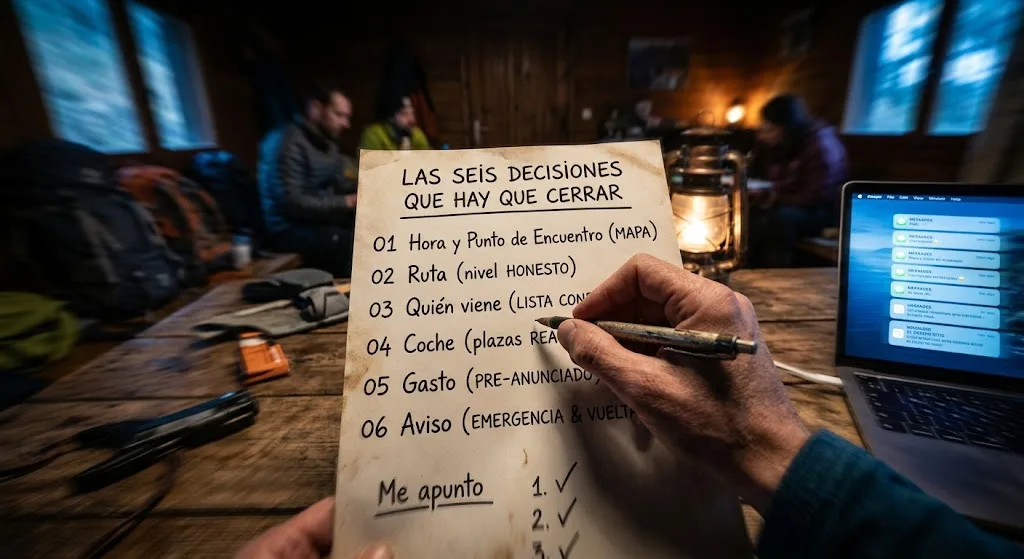
The six decisions you need to settle
A group outing hardly ever falls through because of the route. It falls through because at eleven o’clock on Saturday night nobody knows for sure who’s coming, and at half past seven on Sunday morning someone posts in the group chat ‘so what time was it again?’.
There are six decisions. Not one more. If all six are settled and written down somewhere people can go back to, the outing runs itself.
- 01The time and the meeting point. An exact time and a spot you can open on a map, not ‘at the petrol station on the way out of the village’.
- 02The route and its level. Distance, elevation gain and one honest sentence about who it’s for. The route’s name tells nothing to anyone who doesn’t already know it.
- 03Who’s really coming. Not how many have said yes: how many will actually be at the meeting point.
- 04Who’s driving and how many seats there are. It’s the decision that holds up all the others, and the one that always gets left till last.
- 05How the cost is split. Agreed before you leave, not worked out on the way back.
- 06Who you tell and what time you’re due back. Someone who isn’t going needs to know where you’re heading and when you should be back.
The key number
Six decisions, and the plan ends up scattered across eight places: the main group chat, two private conversations, a minute-and-a-half voice note, a screenshot of the map, the route link, a shared location and the organiser’s head. The eighth place is the problem: it’s the only one nobody can check on Saturday night.
How to count who’s really coming
An ‘I’m in’ in a group chat isn’t a list: it’s an intention. And the gap between nine intentions and six people at the meeting point is exactly what decides how many cars you need.
Three things that fix almost everything:
Set a cut-off and say it out loud. Thursday night. Anyone who confirms after that comes if there’s room, and that gets said on Thursday too, not on Sunday.
Ask for a confirmation that takes a little effort. A thumbs-up on a thirty-line message isn’t a confirmation. Writing ‘I’m coming’ under a list that already has names on it is: when the list is visible, people count themselves in.
‘Almost certainly’ doesn’t exist. It’s a no that hasn’t been written yet. Count those people separately and don’t hold a car seat for them; if they do turn up, it gets sorted in two minutes.
And one more thing, which is what really matters: the important number isn’t how many people are coming, it’s how many car seats there are. Ten people and two cars means eight people.
The cars: seats, pick-ups and who drives
Real seats, not the number in the brochure
5 SEATS = 4A five-seater with five 30-litre rucksacks, five pairs of poles and muddy boots is a four-seater. Have each driver say how many seats they’re offering, not how many the car has. Nobody takes offence and nobody spends an hour and a half with a rucksack on their knees.
One pick-up point, not four
10 MIN PER STOPEvery extra stop costs ten minutes, a phone call and a mix-up. With two cars and four pick-ups, the outing loses three quarters of an hour before anyone has set foot on the trail. One point for everyone, and anyone who can’t make it there sorts out their own way to it.
Decide who drives beforehand
AND ON THE WAY BACKBy default, whoever drives there drives back: otherwise someone ends up asking in the car park, tired, in front of everyone. If you’re going to take turns, say so on Thursday. And whoever has just driven for two hours shouldn’t be the one hunting for a parking space while everyone else changes into their boots.
How to split the cost without it getting awkward
There’s just one rule: the figure gets mentioned before you set off. A split announced on Thursday is logistics; the same split asked for in the car park on Sunday, with everyone hungry, is an awkward scene. The money doesn’t change: the timing does.
The sums fit in three lines.
| Item | How it’s worked out | Example |
|---|---|---|
| Fuel | Total kilometres (there and back) × consumption per 100 km ÷ 100 × price per litre | 180 km × 6.5 ÷ 100 × €1.60 = €18.70 |
| Tolls and parking | As they come, nothing shared out proportionally | €8 |
| Split | Total divided by everyone in the car, driver included | €26.70 ÷ 4 = €6.70 → €7 |
Two details that head off arguments. The driver is included in the split: they’re providing the car, which wears out too, and it makes no sense for them to pay more than anyone else on top of that. And you round up, to a figure people can pay without a calculator: chasing forty cents costs more goodwill than it’s worth.
What breaks groups up isn’t money. It’s surprises.
What to leave word about, and with whom
This isn’t a guide to mountain rescue. It’s the part that means you won’t need one, and it’s four minutes’ work on Saturday.
Tell someone who isn’t going. Not the group: one specific person, who knows the route, the departure time, the estimated return time and – the bit almost nobody mentions – what time to start worrying. Without that last line, the message is no use at all: nobody knows when to act.
Make sure more than one person has the track. Downloaded, not open in a tab. If the route is only on the organiser’s phone, the whole group depends on one battery.
Set a turnaround point, and make it a time. ‘At three we turn back, wherever we are.’ A place gets renegotiated once you’re tired; a time doesn’t.
Assume you’ll have no signal. Anything that isn’t downloaded before you set off stops existing after the first pass.
What Suviard does about this, and what it doesn’t
A club on Suviard sets up an outing, and the event holds everything that today is scattered around: date and time, level, planned distance and elevation gain, the meeting point link and the list of who’s coming. You can check it at eleven on Saturday night without scrolling through four hundred messages.
Cars are part of the event, not a separate conversation: whoever’s driving says how many seats they’re offering and whoever takes them signs up to that car. Free seats are visible at a glance, without anyone having to ask twice. And when the outing’s over, the recorded route stays linked to the event: the club ends up with its own archive of everywhere it’s been.
And now what it doesn’t do, which matters just as much:
That second column is deliberate. Splitting costs and deciding who misses out on a seat are conversations between people who know each other, and an app that automates them doesn’t improve them: it hides them until they blow up. What a tool can do is make sure nobody gets to Sunday without knowing the plan.
In short
Organising an outing isn’t having the plan in your head: it’s having the plan written down where the people coming can read it, with the six decisions settled and a return time that someone at home knows. Everything else – the lovely route, the summit photo, the bar at the end – takes care of itself once that’s done.
To work out your return time without kidding yourself, see how long it really takes to climb 800 metres. And if there are newcomers in the group, what to pack for a hike depending on the route is the message that saves you half an hour of questions on Saturday.
More on how we work with data: about Suviard.